

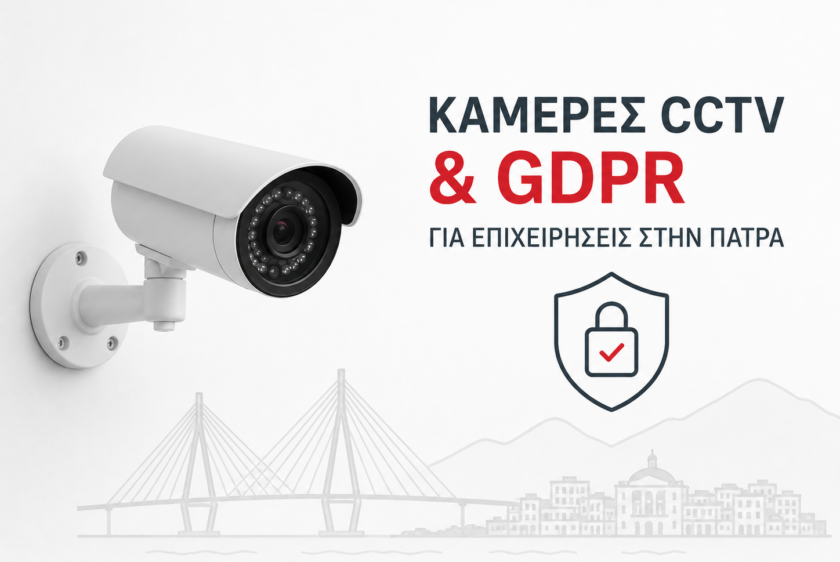
The installation of CCTV security cameras at businesses in Patras is one of the most common choices for protecting shops, offices, warehouses, dining establishments, and other commercial premises. A modern video surveillance system can act as a deterrent against theft and vandalism, assist in incident investigations, and enhance the overall security of a business facility.
However, the use of CCTV is not merely a technical issue. When a camera records identifiable individuals, what takes place is processing of personal dataThis means that a business must take into account the General Data Protection Regulation (GDPR), Greek legislation and the relevant guidelines of the Personal Data Protection Authority (ΑΠΔΠΧ).
For a business owner in Patras, then, the question is not just "what cameras should I install?", but also "where am I allowed to place them, what can I record, and how can I use the system correctly?"
Why do businesses in Patras choose CCTV?
Security needs vary from business to business. A retail store in the center of Patras has different requirements than a warehouse on the outskirts of the city or a high-traffic dining establishment.
The security cameras for businesses can be used for protection of:
- inputs and outputs,
- cash desks,
- goods,
- warehouses,
- equipment,
- loading areas,
- private parking areas,
- critical access points.
At the same time, the presence of a properly designed CCTV system can act as a deterrent, particularly when it is part of a comprehensive solution that includes alarm system, detectors, and Signal Receiving Center.
What is the relationship between security cameras and GDPR?
The GDPR concerns the protection of the personal data of natural persons.
A person's image may constitute personal data when it allows for their direct or indirect identification. Therefore, when a business records customers, employees, visitors, or suppliers, there must be a legitimate and specific purpose for this processing.
In most cases of professional video surveillance, the purpose is related to protection of persons and property.
However, the fact that there is a legitimate purpose does not mean that anything and everything may be recorded. The business must apply the principle of proportionality and limit recording to only what is strictly necessary.
Where can cameras be installed in a business?
The correct placement of the cameras is crucial for both the effectiveness of the system and the protection of privacy.
Entrances and exits
The main entrance of a shop or office is one of the most common locations for installing CCTV.
A camera may cover access to the area, provided its field of view is limited to the necessary point and does not record an excessively large portion of the public space.
Cash Desks
Transaction points may pose an increased risk of robbery or theft. For this reason, their coverage by security cameras may be justified.
However, the camera must serve the purpose of protection, not the continuous monitoring of employee performance.
Warehouses
For businesses handling goods or equipment of significant value, monitoring the entrances, exits, and critical points of a warehouse can serve as a vital security measure.
Outdoor areas
Cameras can also be used to protect private outdoor areas, such as courtyards, loading areas, or private parking spaces.
Recording must be limited to the area concerning the business.
Do you want a proper CCTV assessment for your business in Patras?
Not all businesses require the same number of cameras or the same installation locations. A proper assessment minimizes blind spots, avoids unnecessary recording, and ensures that the equipment meets the site's actual needs.
Check out our security camera and CCTV services in Patras and ask for a personalized proposal for your business premises.
Can a business camera record the sidewalk or the street?
This is one of the most common questions among shop owners.
A camera on a shop front may, due to its positioning, capture a small portion of the outdoor area. However, the business must not—without justification—record a large section of the street, neighboring businesses, or residential entrances.
For example, a camera installed to protect a shop window should be adjusted so that its field of view focuses on the area being protected.
The appropriate shooting angle is therefore just as important as the quality of the camera itself.
What are the rules regarding cameras and employees?
The presence of employees in a workplace does not mean that the business may use CCTV to continuously monitor their behavior or productivity.
Cameras must not be turned into a tool for the daily surveillance of staff.
However, there may be a genuine security purpose at specific points, such as:
- a cash desk
- a money storage space,
- a facility entrance,
- a warehouse with valuable goods,
- an area with increased risk.
The use must always be proportionate to the risk the business seeks to address.
In which areas should there be no cameras?
There are spaces where the expectation of privacy is particularly high.
Characteristic examples are:
- restrooms,
- locker room,
- personal hygiene areas,
- staff rest areas,
- points where there are insufficient safety grounds.
A business owner's general desire to "see the entire space" does not, in itself, constitute sufficient justification for extensive surveillance.
Is a CCTV information sign required?
Yes, transparency is a fundamental principle of personal data protection.
Persons about to enter an area under video surveillance must be appropriately informed.
The relevant signage must be placed in a conspicuous location and provide basic information regarding the system's operation and the data controller, while access to more detailed information must also be available.
A small sign simply stating "the area is under surveillance" should not be regarded as the sole compliance measure.
For how long can the recordings be kept?
The fact that an NVR or DVR has a large storage capacity does not mean that videos must be kept for months.
The fundamental principle of the GDPR is that data should not be retained longer than necessary for the purpose for which it was collected.
The retention period must therefore be determined on a case-by-case basis and in accordance with the applicable regulatory framework.
If a specific incident is recorded, the relevant footage may need to be retained for a longer period for investigation or legal use.
Who can view the CCTV recordings?
Access to the cameras and recorded footage should not be available to all employees of a business.
It must be restricted to specific authorized persons.
Also, a modern IP CCTV system is also a network-connected information system. Therefore, it requires appropriate cybersecurity.
Important measures include:
- strong and unique passwords,
- limited user rights,
- updated firmware,
- secure remote access,
- protection of the NVR or DVR,
- correct network settings.
Using the factory-set code or a shared password among all users is a practice that should be avoided.
CCTV and alarm systems: why do they work better together?
Security cameras and alarms have different roles.
A CCTV system provides visual surveillance and recording of an incident. An alarm system has as primary goal to detect a breach in a timely manner and trigger an alert.
Η ολοκληρωμένη προστασία ενός επαγγελματικού χώρου στην Πάτρα μπορεί να περιλαμβάνει:
- CCTV cameras,
- alarm,
- magnetic contacts,
- motion sensors,
- sirens,
- remote control,
- connection to the Signal Receiving Center.
The right choice depends on the type and location of the business.
Upgrade your business's overall security.
Cameras can show you what is happening on your premises, while an alarm system can provide immediate notification when a breach is detected.
Discover our solutions for alarm systems for commercial premises in Patras, and combine CCTV, an alarm system, and a Signal Receiving Center into a comprehensive protection solution.
Common mistakes businesses make with CCTV cameras
Many problems do not stem from the technology itself, but from incorrect installation or use.
The most common mistakes are:
- Cameras with an excessively wide field of view.
- Recording of adjacent areas without necessity.
- Use of CCTV for continuous monitoring of employees.
- Absence of appropriate informational signage.
- Storing video for an excessively long period of time.
- Access to the system by multiple unauthorized individuals.
- Weak passwords on the recorder or IP cameras.
- Installation without a prior technical study.
Proper planning prior to installation can prevent many of these problems.
How do you choose the right CCTV system for a business in Patras?
There is no one-size-fits-all system.
A small shop might need just a few cameras at specific locations, whereas a warehouse or large commercial facility may require perimeter coverage, more recording points, and advanced management capabilities.
During the design process, factors such as the following are considered:
- the layout of the space,
- entry points,
- the lighting conditions,
- the need for night shooting,
- the distances,
- the required storage time,
- the possibility of remote access,
- the network infrastructure,
- the system's expandability.
High image resolution is important, but it is not enough. A high-quality camera placed in the wrong location can prove less useful than a well-planned installation.
CCTV cameras in Patras: local technical support matters.
A professional security system is not complete on the day of installation.
Over time, the following may be required:
- changes to settings,
- expansion with new cameras,
- technical inspection,
- change of storage medium,
- software update,
- network reset,
- transport of equipment following renovation.
That is why access to technical support in Patras is a crucial factor for a business that wants its CCTV system to remain functional and effective.
Conclusion
The CCTV security cameras for businesses in Patras can form a key part of a comprehensive security strategy.
However, their installation must strike a balance between protecting the business and respecting personal data.
Proper design entails a specific purpose for video surveillance, suitable installation locations, a limited field of view, controlled access to recordings, appropriate notification, and secure system management.
At the same time, the combination of CCTV with alarm system and Signal Receiving Center can offer much more comprehensive protection than the use of a single technology.
Note: The content of this article is for informational purposes only and does not constitute legal advice. Regarding specific issues of GDPR compliance and personal data protection, a business should assess its own situation with an appropriate legal professional or data protection consultant.
Do you need security cameras for your business in Patras?
Every business premise has unique risk areas and specific needs. A proper assessment can help you select the right cameras and optimal installation points, as well as a system that can expand as your business grows.
Contact us for the design and installation of CCTV cameras in Patras, and request a personalized proposal for your business premises.

